Motivation
Tree-structured data is everywhere — code ASTs, CSG solid-modeling
trees, parse trees — yet existing generative models do not handle them
well. Graph-diffusion methods such as DeFoG achieve strong results on
general graphs but pay O(n²) complexity for the adjacency
matrix and cannot natively express tree-specific constraints
(acyclicity, single-parent rule). Tree-diffusion methods, on the other
hand, rely on hand-crafted CFG rules and are typically bounded to a
fixed depth or domain. Variable-length sequence flow matching (Edit
Flows, NeurIPS 2025) shows that edit operations can model length
variability — but only in 1D.
Goal
Construct a generative framework that produces variable-sized rooted K-ary trees while keeping implicit structural rules (acyclic, single root, valid parent–child) satisfied throughout the entire generation trajectory.
Method
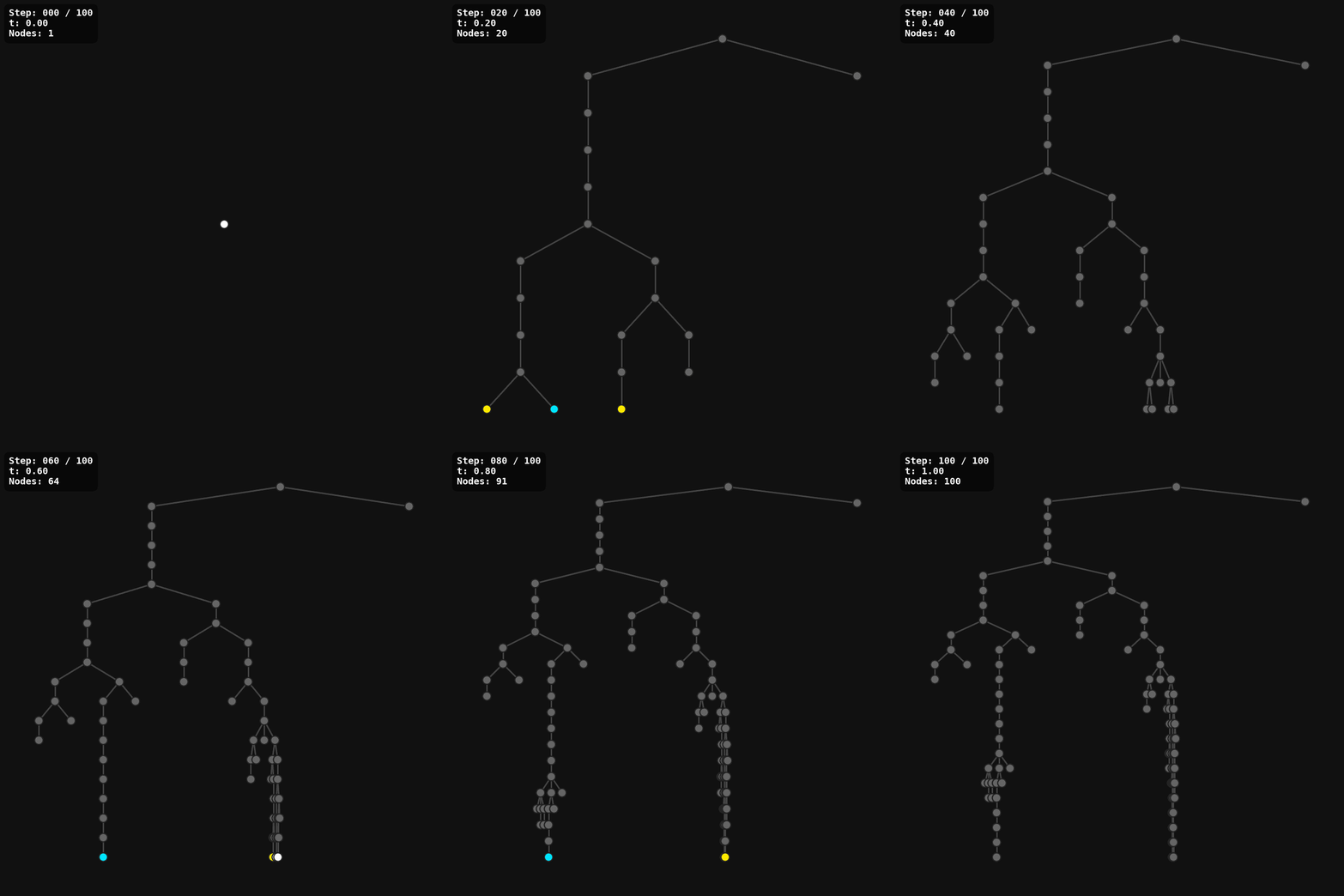
Discrete Flow Matching on trees. The interpolant
between a root-only reference tree and a target tree is projected onto
the manifold of valid trees at every t. The projection
cascades deletions of unreachable subtrees, keeping state-space
complexity at O(kN) instead of k^d.
Edit-flow CTMC over tree slots. Three operations act on the tree's empty / non-empty slots:
-
Ins(x, i, r, c)— insert a node of typecinto an empty slot -
Del(x, i, r)— delete a node and cascade-remove its descendants Sub(x, i, r, c)— substitute a node's type
The network outputs per-slot OP rates (λ_ins,
λ_del, λ_sub) and per-operation type logits
(π_ins, π_sub), which together define the
generating velocity in a Continuous-Time Markov Chain that is
well-defined only on valid trees — a semi-autoregressive scheme.
Training loss. A Bregman-KL objective on the rates with three branches (ins / del / sub) keeps the velocity field consistent with the projected interpolant.
Sampling. Tau-leaping sampler — at each step, the
number of events per slot is drawn from a Poisson process with rate
λΔt, giving event probability 1 − e^{−λΔt}.
Experiment — Maze Generation
The framework is evaluated on maze generation: a maze is a spanning tree of a grid, so the task probes whether the model genuinely learns the tree manifold rather than just plausible-looking graphs. Comparison is against DeFoG (graph-level discrete flow matching) and an Insertion-only ablation that disables the deletion and substitution operations.
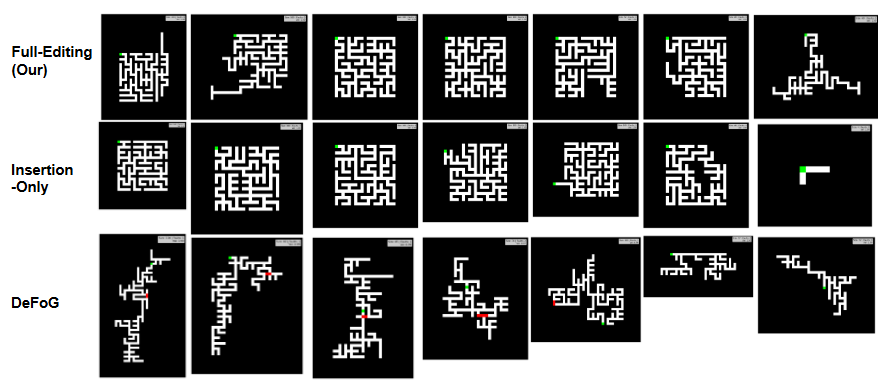
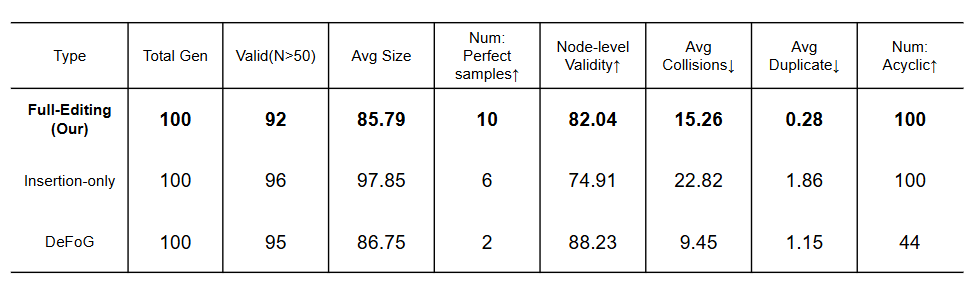
The clearest signal is in acyclicity: 100/100 valid trees from our method versus 44/100 for DeFoG — direct evidence that the projection step plus edit-based CTMC gives the structural guarantees that adjacency-matrix diffusion does not. Perfect samples are also markedly higher (10 vs 6 vs 2).
Takeaways
- Designed a non-trivial extension of discrete flow matching to a structured (non-1D, non-fixed-size) state space
- Engineered the projection step that makes the CTMC well-defined on the tree manifold
- Derived and implemented the rate-based Bregman-KL training loss and the tau-leaping sampler